This week’s Thursday Throwback focuses on a design classic as iconic as the brand itself; the Ferrari F40. Developed in the power crazed 80’s and becoming the first production car to have a quoted top speed that broke the magic 200mph barrier, the legendary status of the machine was assured from the very beginning. As quite a few other iconic cars of the era, its origins begin as a proposed challenger to take on the might of Group B rallying which subsequently became too dangerous and was cancelled before it really got going. The original plan was to create an evolution model of the famed 288 GTO to take on the likes of Porsche and their 959, however when the series was cancelled Ferrari were left with 5 examples of the car and no racing series to compete in. Enzo wanted to leave a legacy with his final supercar and as such, the car was to be developed into a road going example and redesigned as the F40.
Ferrari had been criticised that their cars were becoming too comfortable and were keen to avoid the high technology and computer aided direction that Porsche had taken their 959 in, instead plumping for hardcore racing car thinking and principles. The weight was kept to a minimum thanks to Kevlar and carbon fibre bodywork, with paint so thin that you could see the weave of the carbon fibre through it. The weight saving was instructed to such an extent that the F40 had no door handles, replace with a piece of string, no radio, although you’d struggle to hear it over the engine noise and early models only had sliding windows. Later models had the luxury of windows you could wind down but even then it had to be done by hand. There were no carpets at all, just lashings of bare carbon fibre and Kevlar and the cabin was abundant with exposed glue seams, welds and roughly fitted together trim pieces. The switches were very basic at most and the whole dash was trimmed in a thin layer of what looked like the same rough carpet they cover subwoofers in. But it didn’t matter. Ferrari hit back at critics of their ‘too much comfort’ approach with a 470bhp go-kart. A barely road legal showcase of the very finest engineering the prancing horse could offer and an exotic performance orientated racing derived bare knuckle supercar. The twin turbocharged engine might have only been 2.9 litres in size, but the light weight of the car and its forced induction assisted power made the performance figures mind boggling for its time. With a top speed of 201mph and 0-60 in 4.5 seconds the F40 could keep up with a lot of modern day supercars.
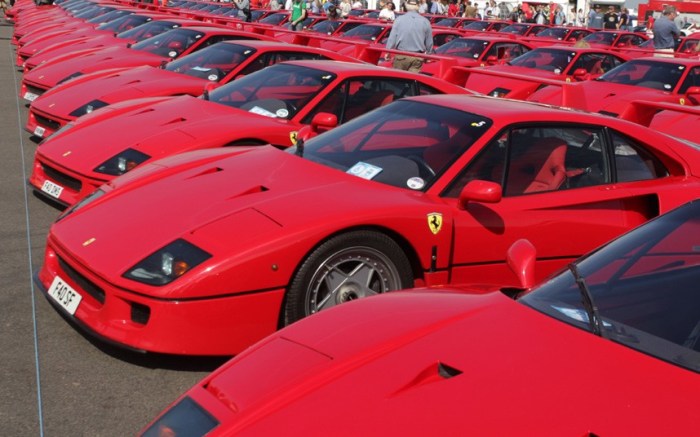
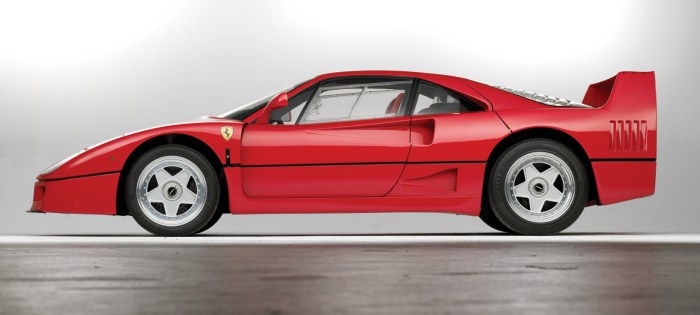
With the Pininfarina designed bodywork Ferrari created a sculpted angular look to their new F40, with speed and aerodynamics the driving factor in its styling. A bit of an angular departure from the usual works of designer Leonardo Fioravanti, the previous sculptor of the curvaceous Ferrari Daytona, 512BB and 308 GTB models. The use of pop-up headlights, a popular design choice of the 80’s, allowed for a very low wedge shape to the front of the car creating a clean edge to cut through the air at speed. A mostly flat clamshell bonnet across the whole width of the car, with squared off bulges rising over the wheel arches, worked well with the design of the square headlight covers, angular light covers and wedged front end. Simple double vents adorned the top of the bonnet in a triangular tailed off style, a design detail that also found its way to the side air intakes and cooling ducts. A black shadow gap detail runs all the way round the car, something which you will also find on today’s LaFerrari model only a little more subtle, removing the need for awkward panel joints on the expensive carbon fibre bodywork.
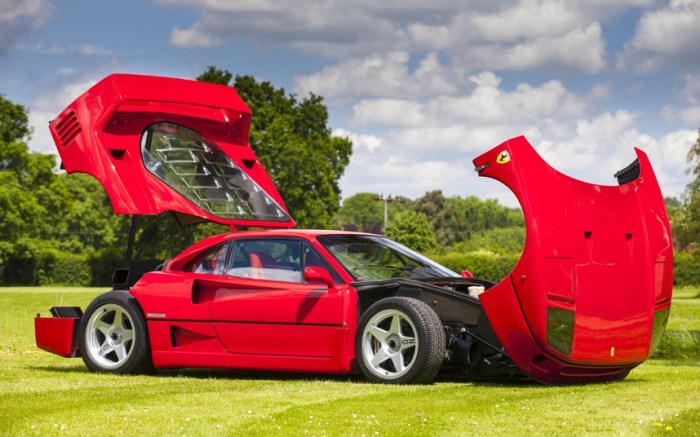
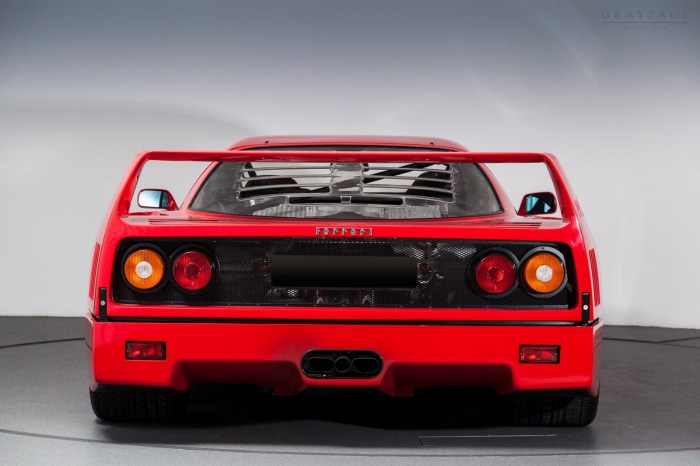
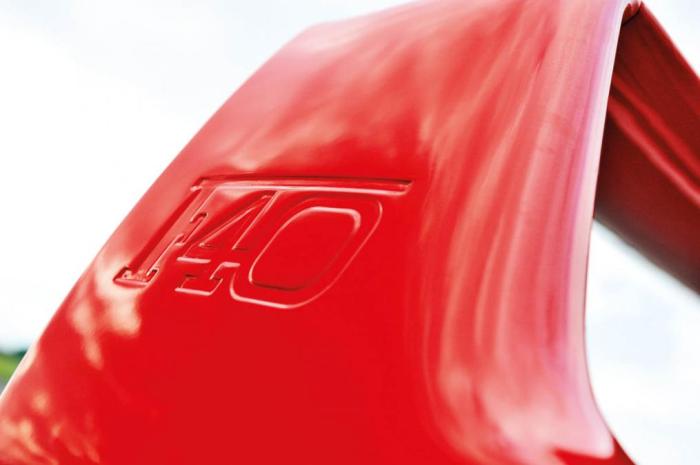
Vents and ducts abound on each side of the car brings the design detail round to the back and easily the most iconic feature of the F40; the enormous rear wing. In a time when Lamborghini were adding a huge wing to their Countach, and Porsche, although less ostentatiously, integrated theirs into the design for the 959, Ferrari trumped the lot with their huge square rear spoiler. The straight sides complete with embossed F40 logo on each side, and flat top provided the necessary downforce and aerodynamic aid the car needed to stick it to the road, yet became an icon of the model and the outlandishness of its performance. The square form of the spoiler finished off the back of the car perfectly, forming a blunt straight edge to the rear from the side profile, and allowing a clear view from behind of the iconic engine cover. The engine could be seen through the plastic rear window, itself heavily grooved and open to the elements in order to provide necessary cooling to the famously immense heat generating 2.9 litre twin turbo race derived engine. Cooling was assisted by the fact that most of the rear of the car in between the squared bodywork was in fact mesh to allow the heat to escape unobstructed. Simple round rear lights, a styling detail that Ferrari continue to use today, poked out between the mesh, with very little bodywork to the top half of the car’s rear. In the middle another iconic styling design is the exhaust arrangement. Arranged in a bank of three, with the two large oval shaped outside pipes for each bank of the V8’s engine emissions and the smaller central round exhaust for the wastegate of the turbochargers, the triple exhausts became an instantly recognisable design detail of the car.
In an age when technology was beginning to take over in most aspects of everyday life, including the extensive amount that Porsche had crammed into their 959, the F40 was a return to advanced engineering know-how over advanced technology. The basic stripped out nature of the car had enabled drivers to experience the real thrill of performance without restricting the enjoyment through computerisation. It didn’t matter that it was loud, uncomfortable, unforgiving and had lashings of turbo-lag when you put your foot down, Ferrari had produced the ultimate supercar of the era, and for many the greatest supercar ever made. Just over 1300 were made and sold making it a huge success for the marquee, however if you manage to find one for sale today and are feeling a bit flush, it’ll definitely be a buying experience you wouldn’t regret, especially the way prices are appreciating these days.
 Search ‘CarDesignBlogUK’ or on iPhone or iPad click: here

 HYPE Automotive