This week’s Throwback Thursday post comes from one of motoring’s most famous examples of ambitious dreams and pioneering spirit that came crashing down just as spectacularly. One of the most radical ideas of producing a dream car that everybody could afford, full of future technology and advanced construction methods, and at the same time securing one of the most popular product placements of all time to accompany that dream. The company in question is the DeLorean Motor Company and their radical DMC-12.

In the late 1970’s into the 1980’s the world was turning power and money crazy. Technology was creating a new digital age with the (somewhat) ‘mobile’ phone, computer processors and brash neon advertising and brand marketing graphics. Wall Street was creating a generation of new money richness the world had yet to experience and they were looking for radical, flash excess to show off their new found wealth. The car design world was no exception. Spoilers were growing to near airplane sizes, vents and grilles were abundant and sharp angular styling was the way forward. The supercars of the time were all wedge shaped, low and wide in stature and, obviously apart from the ever present bug-eyed Porsche 911, designed with rulers and straight edges resembling the blocky pixilated digital era to a tee.
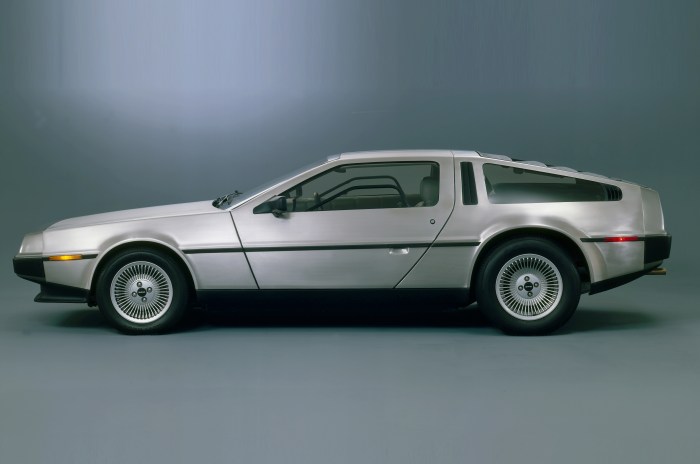
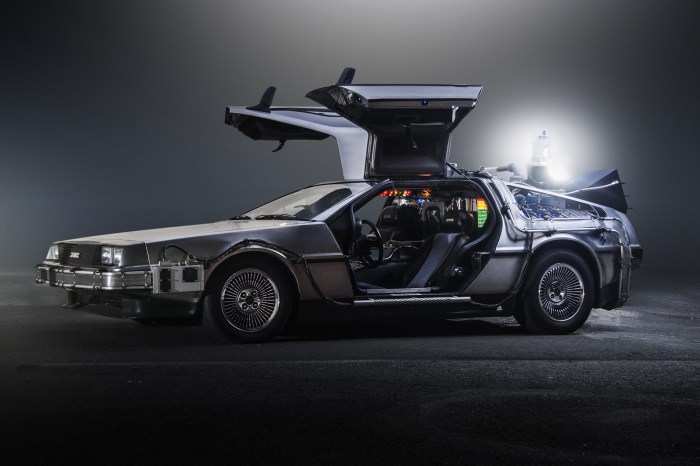
Up steps John DeLorean and the newly founded DeLorean Motor Company. He had a dream to produce something that could match the styling and exotic design of the world’s finest supercars and bring it to people at a fraction of the price. The new DMC-12 concept, named 12 for the $12,000 it was originally projected to retail for, certainly embraced the design and look of the age, with low wide angular bodywork and futuristic styling and ideas. An abundance of flat panels and squared off edges coupled with the square lights, grille and angular window line created an appearance that only the most expensive of supercars were sporting. The design features, however, did plenty to give the car a unique look and appearance that even they couldn’t match. The body was styled by Giorgetto Giugiaro of Ital Design and panelled in unpainted brushed stainless steel, creating a modern industrial look to the car. Doors were of the gullwing variety to add theatre to every entrance and the rear lights looked like they came from the set of a futuristic space series. The styling cues were as eccentric as the idea of a supercar for a budget price itself, with slatted rear window cover, multispoke turbine style wheels and a chassis scheduled to be made from a completely new and untested elastic moulding process. The only options available were between manual or automatic and whether you wanted a grey or black exterior, everything else was standard and not available to be changed. All of this meant that the car was also the perfect choice for any sci-fi fanatic, leading to one of the most iconic film-car relationships of all time; the Back to the Future franchise. The futuristic styling, eccentric gullwing doors and unique design meant that the car became an icon of Hollywood and a key feature of the films. Yes it might have had a few cosmetic additions, and the odd flux capacitor thrown in, in order to become the time travelling machine that it was, but no other car would have looked more at home travelling to the future or create such a stir when it got there.

Sadly, however, the vision was as optimistic and outlandish as the time travelling theory in Back to the Future. Financial troubles and manufacturing issues meant that a lot of the early ideals were changed and then changed again to meet requirements or budgets. The original plan for a mid-mounted rotary engine made way for a rear mounted Ford V6, which was then replaced again for a French/Swedish powerplant from a Peugeot/Renault/Volvo partnership, as was the gearbox. The radical chassis production technique was deemed unsuitable, despite DeLorean purchasing the patent rights specifically for the job, and complete re-engineering was eventually passed on to Lotus to see if they could salvage something that could at least be built using knowledge from the Esprit platform. The car was manufactured in Northern Ireland by largely inexperienced workers equipped with the very best machinery, but the assembly and fit quality couldn’t match similarly priced cars of the era. Production costs were over budget, the car was overpriced, were delivered late and performance figures didn’t meet the original quoted statistics. In the space of a few short years the company went bankrupt and production of the DMC-12 stopped in a whirl of bad press, poor workmanship and huge sums of money seemingly gone down the drain.

So does this mean the DMC-12 was a failure. In a commercial sense it certainly was, it terms of a quality piece of craftsmanship and performance was and ultimately it was never the car it originally promised to be. But to so many it was so much more than that. The car, with the help of Doc and Marty McFly, has become an icon of its time, a design classic and has generated a cult following around the world. It may have had overly heavy doors, badly fitting panels, poor performance, radio aerials that would struggle to pick up any signal and the unpainted bodywork meant refurbishment or repair was extremely tricky, but nothing says early 80’s style as quintessentially as the DeLorean. It might have cost more than double its intended price of $12,000 but over 9,000 were made and sold and even more unbelievably 6,500 are believed to still exist. They even tried to market gold plated editions in a collaboration with American Express to their gold card members at the crazy price of $85k, but unsurprisingly only 2 were sold to the public.
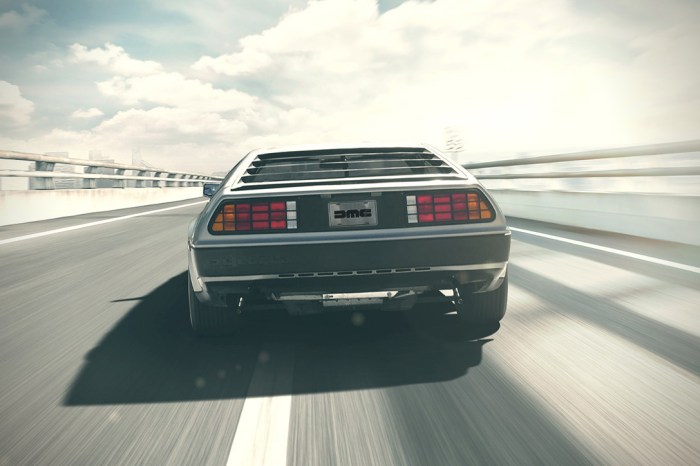
The car was a bold idea from the beginning, and maybe if it had been more conservative and less exotic supercar crossed with a spaceship it might have survived, but it wouldn’t have become the motoring legend it is today. Financially it may have been a flop, but something that creates such a stir in terms of style and appearance that it is still lusted after today has to be deemed a design success. Such is the love and demand for this iconic car that the rights have been bought by the newly formed DMC Texas to produce ‘new’ or recreation DMC-12’s from left over and sourced original parts and replicas. They may be priced at nearer $100k, but you’d struggle to look cooler in any other 80’s car for the same money. Better move quickly though as only 50 a year are to be made and there’s sure to be a long waiting list for that time-travelling machine.
Read more on Apple News, click here on your iPhone or iPad to view.


 HYPE Automotive