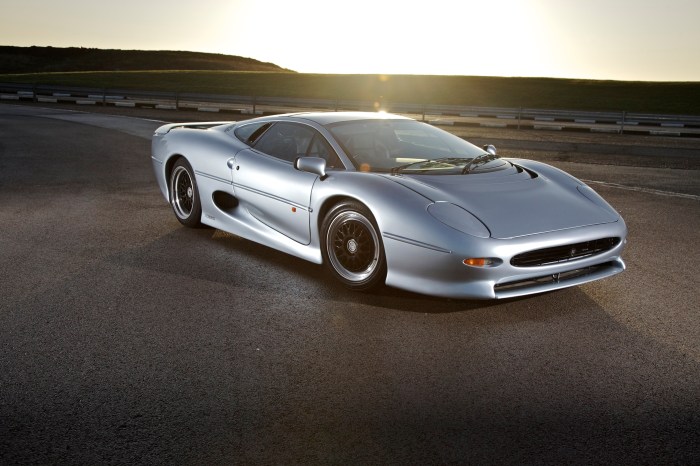
This week’s Thursday Throwback blog post is a car that is a symbol of British engineering greatness, a moment to be proud of what our motor industry can achieve when they’re on form. However it’s also a car that at the same time was renowned for being too expensive, too large, too unnecessary and built from borrowed parts from much cheaper mundane every day cars. It took on the world and triumphed in the speed stakes and pushed the boundaries further than ever before becoming the fastest car in the world in the early 90’s, if only for one short year before McLaren’s F1 kicked it into touch.
Like most design greats the Jaguar XJ220 was conceived as a project by employees in their spare time. Created as a modern take on the illustrious racing legends that the company produced in the 1950’s and 60’s, its aim was to take on the mighty FIA Group B with four wheel drive and a roaring V12 using technology from their current racing line up. The project resulted in a concept that would be unveiled at the 1988 British Motor Show. Such was the last minute nature of the project that it was finished a mere 3 hours before being transported to the British Motor Show, to be unveiled to the awaiting public just 5 hours later. The company marketing department hadn’t even seen the car themselves until the unveiling and had left a space on the stand for the eagerly awaited car. The car itself was not initially intended be a road car yet overwhelming interest from wealthy clients and the interest that overshadowed even the F40 was enough to persuade Jaguar that it had to make other plans. A limited production run of between 220 and 350 cars was initially scheduled at a price of £290,000 but that number was more than 4 times oversubscribed with clients placing deposits of £50,000 a time.
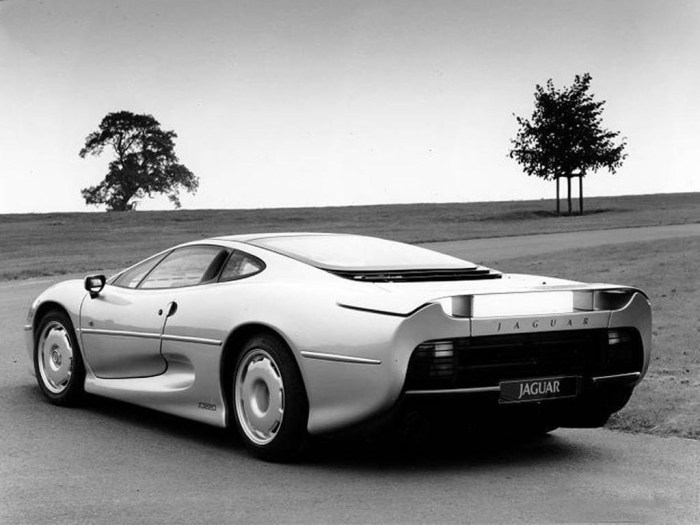
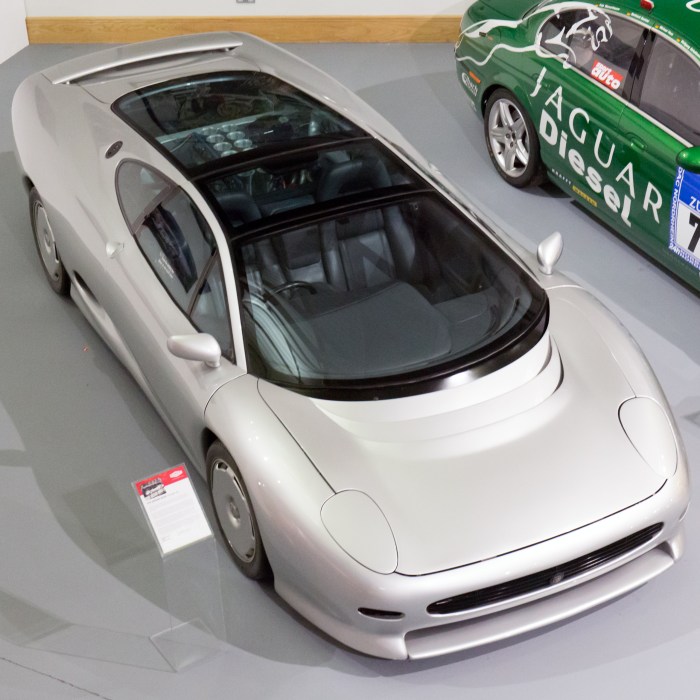
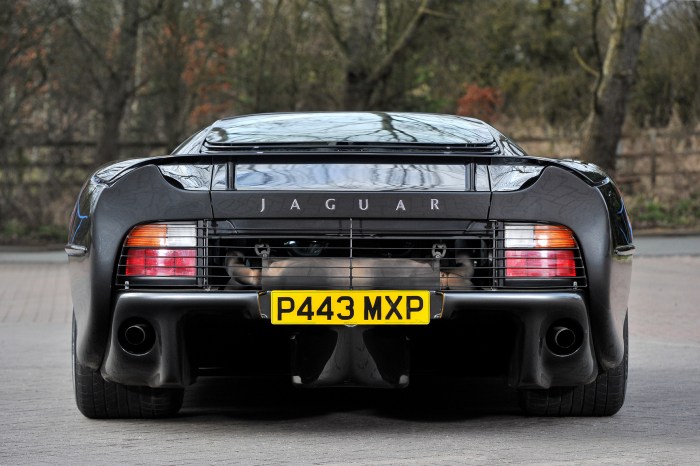
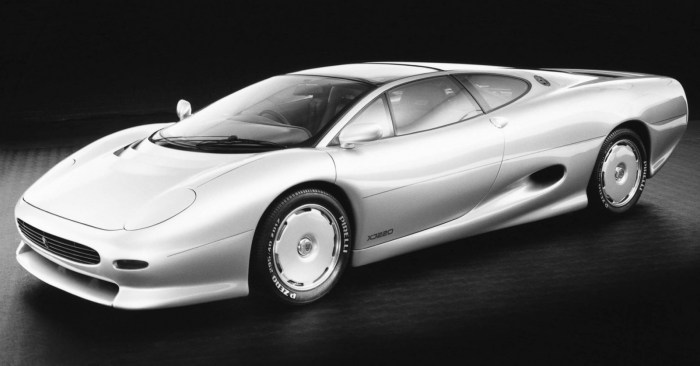
Designed on a budget and mostly created by calling in favours from design companies and engineering suppliers, the resulting concept car was a thing of unrivalled 90’s beauty. Endlessly long and sleek, the handcrafted aluminium body sure looked like it had been shaped with at least the top speed in mind or even more. Inspiration from days gone by for sleek racing designs of the D and E-types created an aerodynamic masterpiece abundant with curves and rounded edges in all the right places. The trademark Jaguar oval grille had been stretched to suit the cars massive width and set the precedent for the low moulded front to the car. The penchant of the era for pop-up headlights meant large oval covers hid the headlights to create the slipperiest shape possible for the front whilst lights weren’t needed. A seemingly near horizontal windscreen swooped up from the louvered bonnet and created a clean middle section of glazing with clean uninterrupted lines to cover the complete middle section of the car. The huge engine was visible through the glass rear screen which itself appeared as a continuous glass expanse from the windscreen to the boot lid, contrasting which ever colour you chose your XJ220 perfectly. A subtle built-in rear spoiler finished off the back of the car in a neat yet aerodynamically functional manner, with variable rear wing depending on the speed and racing intent. A horizontal full length grille finished off the rear profile aiding airflow, engine cooling and concealing the rear light clusters for a clean minimalist appearance.
The interior was a place of pure luxury and an approach to a supercar that hadn’t been tried before. The lashings of leather and a wrap around dash that, together with the low roofline, cocooned you in the cabin gave a sense of plush surroundings and unrivalled comfort. The ride was Rolls Royce smooth at any speed and the interior only had room for two, remarkable for something with such large exterior dimensions. There was an air or craziness to the car, perhaps hinting at the fact that it was developed as a side project, with a distinct lack of useful storage anywhere, even the boot was ridiculously too small. The interior wrap around dash was in fact so wrapped around the inhabitants that there was a section of the dashboard on part of the door. Gauges in the door; a definite sense of British eccentricity with a design decision like that one.
At the time, the world had seen supercars from Porsche with their 959 and Ferrari with their F40 but the Jaguar was clearly a different approach. The Porsche wowed people with their high tech approach and futuristic systems that brought new levels of power and handling to road going cars. Ferrari used their racing knowledge to create a wedge-shaped lightweight masterpiece, stripped out and made from cutting edge carbon fibre it became the first road car to break the 200mph barrier. Jaguar decided brute force was needed and looked to their extensive race car collection for a donor engine, reworking a racing V12 to produce the 6.2 litre monster that would enable the car to live up to its ‘220’ name.
By the time the car was ready for production, emission regulations and power requirements meant that the enormous V12 engine was replaced by a modified version of the 3.5l V6 power plant from the Metro 6R4, with 2 enormous turbochargers strapped on to create 540bhp. This meant that the car’s length could be reduced due to the smaller engine, although not that you would have noticed, it was still a full 870mm longer than the Porsche and 710mm longer than the Ferrari as well as significantly heavier than both. However power output and size were unfortunately the least of the big Jag’s worries. Criticisms of the car’s interior being too comfortable (?) and as a supercar that it was lacking a sense of occasion were not helpful, not helped by the promise of a roaring V12 that had removed some of the appeal now that it had been replaced by a reworked V6. Parts borrowed from other cars in the parts bin meant that items such as the rear light clusters were taken straight from the Metro, not the kind of exclusivity consumers were after. The recession meant that many who had left deposits were unable to complete the purchase, especially now that £200,000 had been added to the price of the car. Sales of supercars were very slow, even classic car’s value had plummeted leaving the final XJ220 production run short at 275 cars in 1994, and even some of those remained unsold for another 3 years. Jaguar’s own decision to produce a road going version of the V12 and advanced technology laden XJR-9 didn’t help matters and some later XJ220’s sold for a mere £127,000 in 1997.
Like many an artist the Jaguar was ultimately unappreciated in its time. The expense and timing weren’t kind to the XJ220 and it became a victim of its original promise and concept success. The design was flawless, a testament to aerodynamic sculpting and the attempt to push the limits of speed to new levels. The immense size and weight of the car together with the approach of equipping such performance with the height of luxury, arrived at a time when people were used to high technology and weight saving. The aesthetic appeal of the car, however, never seemed to decline and the appreciation of recent prices for the car is a sign that it is seen as a definite supercar classic. Seeing an example in the flesh still creates a surprised reaction of the sheer size of the car, yet the svelte styling and curvaceous lines mean that it doesn’t appear ungainly. If anything can prove that big is indeed beautiful, the Jaguar XJ220 is the perfect example. I’ll have mine in silver please.

 HYPE Automotive
A great car for its time ! How stunned I was when I saw it for the first time and that I realized that it wasn’t a Rari nor Lambo ! Unrivalled indeed, even if I’m a great Lamborghini fan…
LikeLiked by 1 person
Just a shame it came at the wrong time financially, good to see that the classic car world is appreciating the car though and prices are on the rise. Always had a soft spot for the big Jag
LikeLike